Type
Type
Independent
Independent
Role
Role
UI / UX Design
UI / UX Design
Research
Ideation
Ideation
Branding
Prototyping
Prototyping
Timeline
Timeline
May - August 2025 (12 weeks)
May - August 2025 (12 weeks)
Tools
Tools
Figma
Figma
After Effects
After Effects
LUMI
LUMI
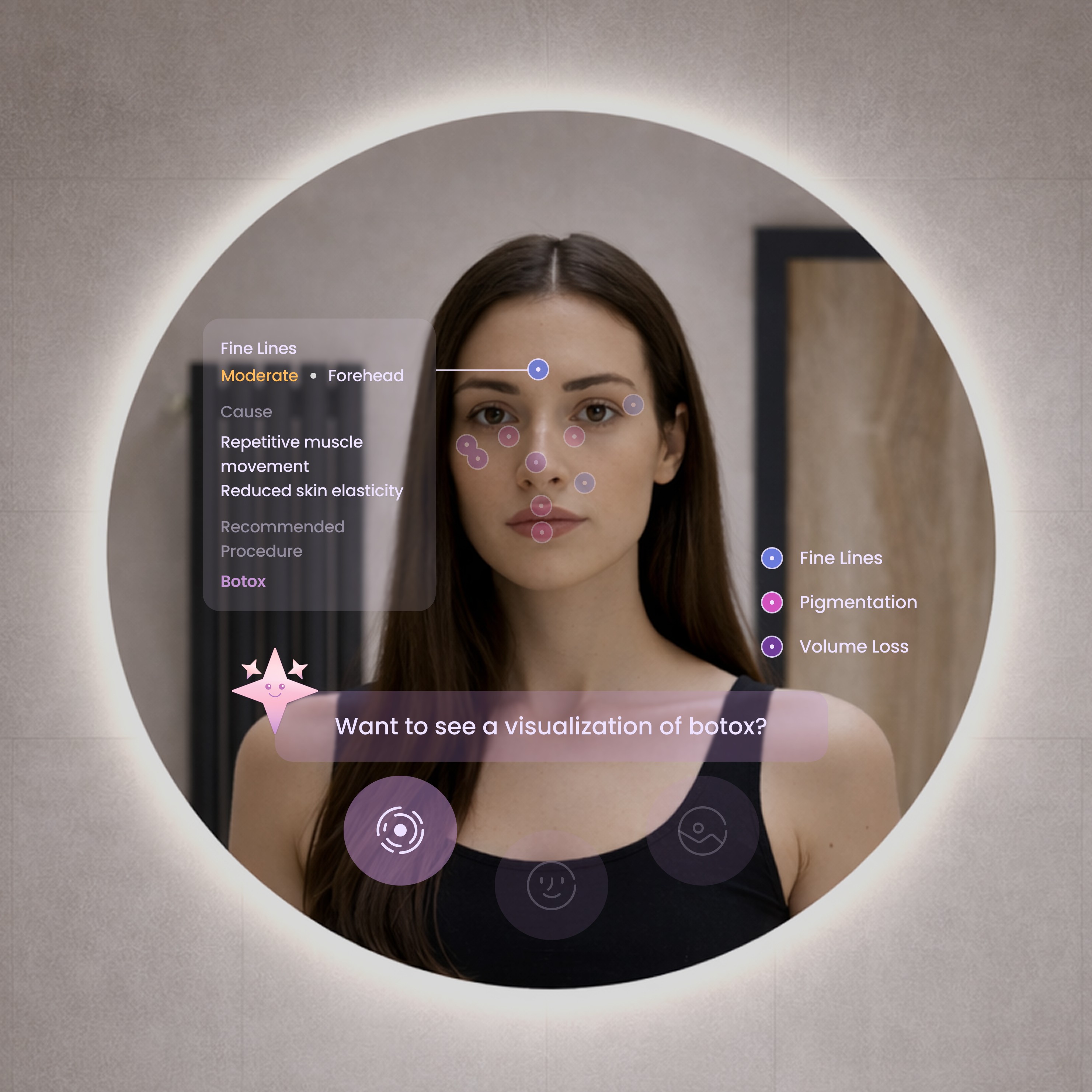
An AI-powered smart mirror ecosystem designed to improve user understanding, confidence, and decision-making in personalized medical aesthetic treatments.
An AI-powered smart mirror ecosystem designed to improve user understanding, confidence, and decision-making in personalized medical aesthetic treatments.
The Problem
The Problem
Newcomers to medical aesthetics lack facial literacy
Newcomers to medical aesthetics lack facial literacy
Clinics often frame advice around what they sell, not what the face actually needs
Clinics often frame advice around what they sell, not what the face actually needs
This asymmetry creates misinformation, anxiety, and unnecessary procedures
This asymmetry creates misinformation, anxiety, and unnecessary procedures
The Solution
The Solution
A bathroom mirror–attached visualization system that helps users how to read their own face—so they can make informed decisions before entering a clinic.
A bathroom mirror–attached visualization system that helps users how to read their own face—so they can make informed decisions before entering a clinic.
Context
Context
My experience as a medical aesthetic beginner revealed a gap between seeing facial changes and understanding them. That gap—between personal perception and clinical recommendation—shaped the motivation for designing LUMI.
My experience as a medical aesthetic beginner revealed a gap between seeing facial changes and understanding them. That gap—between personal perception and clinical recommendation—shaped the motivation for designing LUMI.
The market for cosmetic procedures has been climbing steadily at an average rate of around 7% year over year.
The market for cosmetic procedures has been climbing steadily at an average rate of around 7% year over year.
Nextech, 2025
Nextech, 2025
User Research
User Research
I interviewed people who were curious about medical aesthetic treatments but unsure where to begin, focusing on two central questions:
I interviewed, focusing on two central questions:
Competitive Analysis
Competitive Analysis
I analyzed existing products across medical aesthetics, consumer beauty, and smart assistants using multiple visualization frameworks, focusing on user agency and depth of facial understanding.
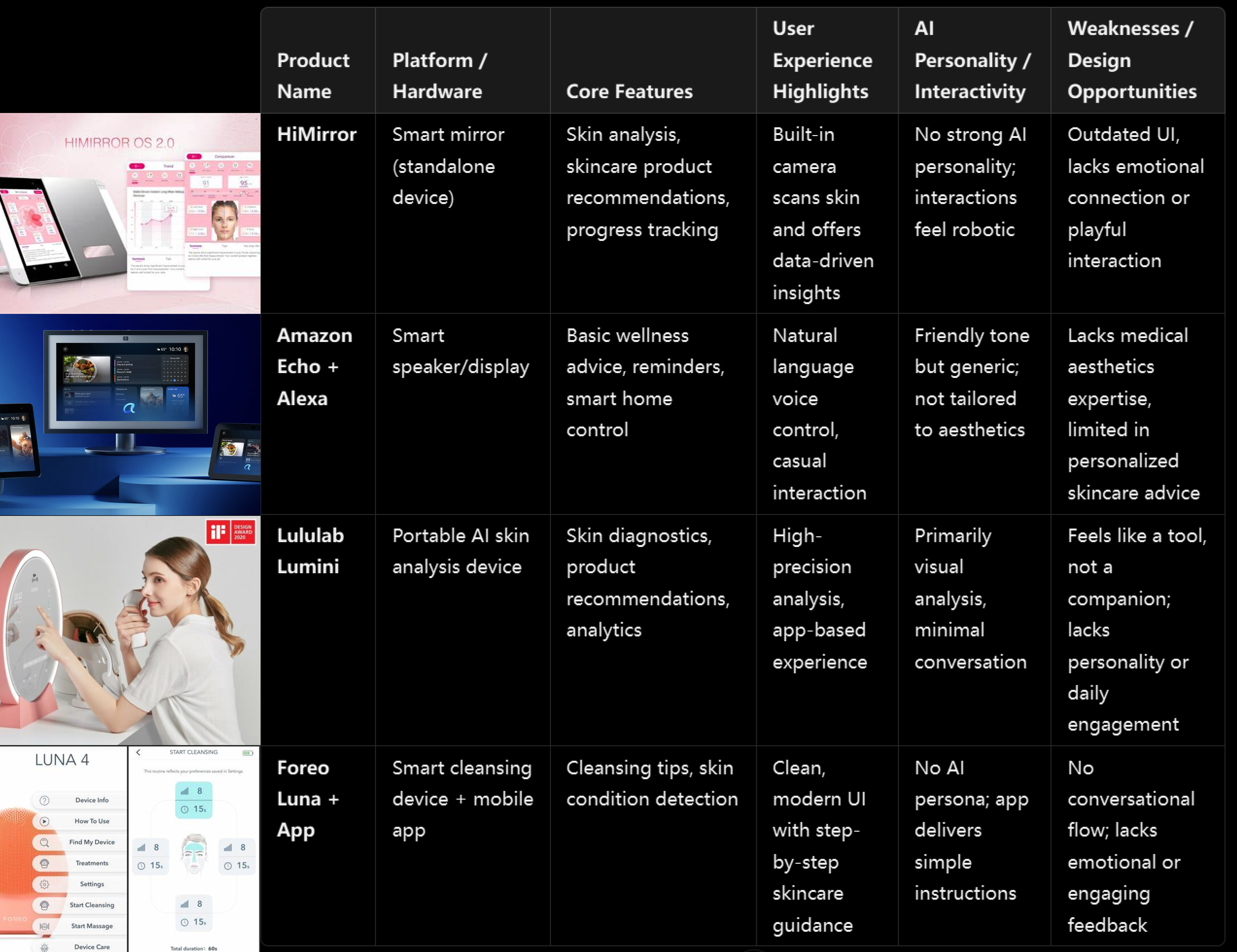
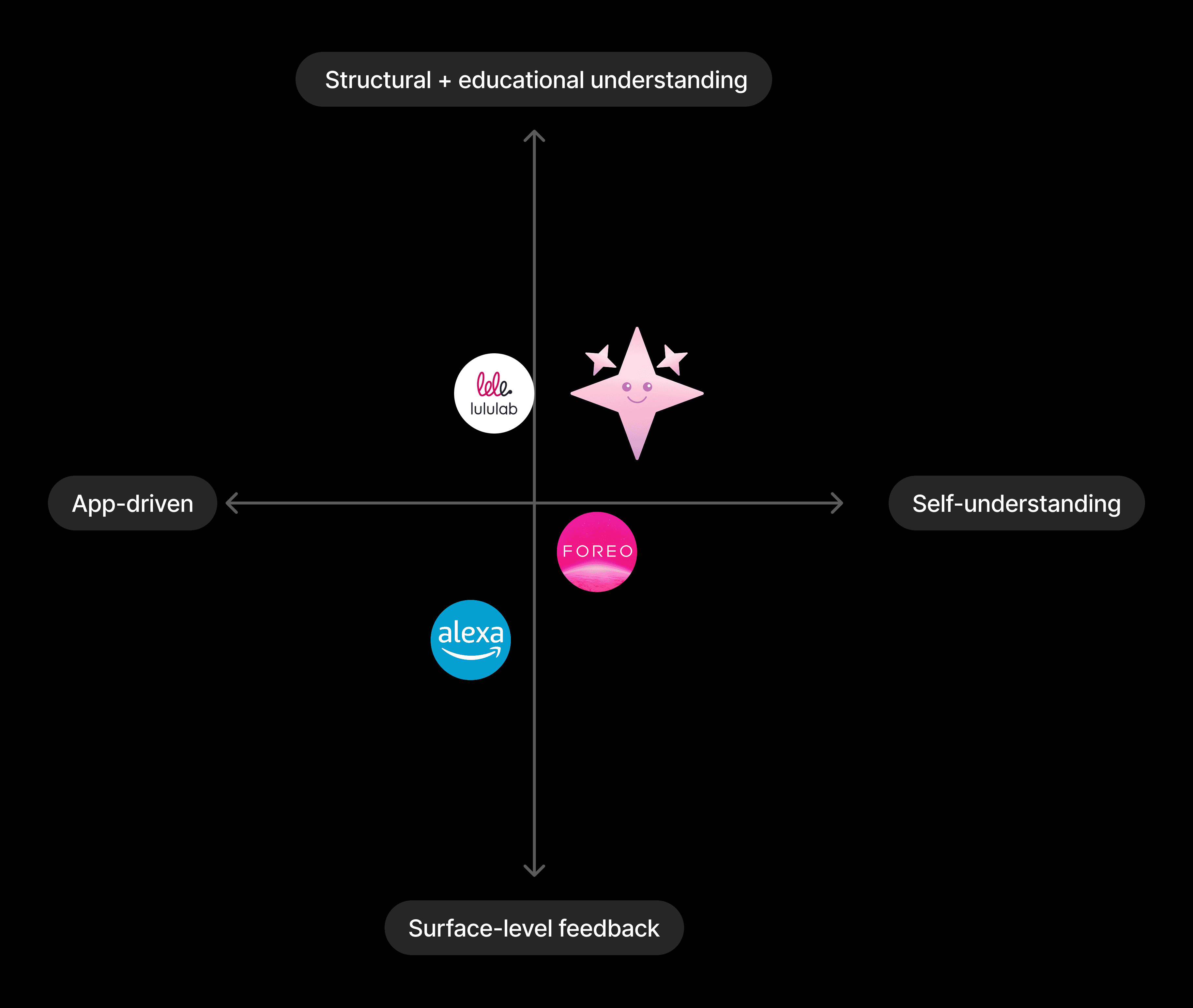
I analyzed the competitors with multiple visualization tools,
FloraSense asks:
How might we help first-time medical aesthetic users learn to read their own face—so they can make informed, confident decisions before entering a clinic?
How might we help first-time medical aesthetic users learn to read their own face—so they can make informed, confident decisions before entering a clinic?
How might we help first-time medical aesthetic users learn to read their own face—so they can make informed, confident decisions before entering a clinic?
Design Goals
Design Goals
Goal 1
Goal 1
Help users understand why changes appear on their face
Help users understand why changes appear on their face
Goal 2
Goal 2
Rebalance information asymmetry in medical aesthetics
Rebalance information asymmetry in medical aesthetics
Goal 3
Goal 3
Offer clear, calm explanations before users encounter clinic sales pressure.
Offer clear, calm explanations before users encounter clinic sales pressure.
Goal 4
Goal 4
Support gradual / over time understanding
Support gradual / over time understanding
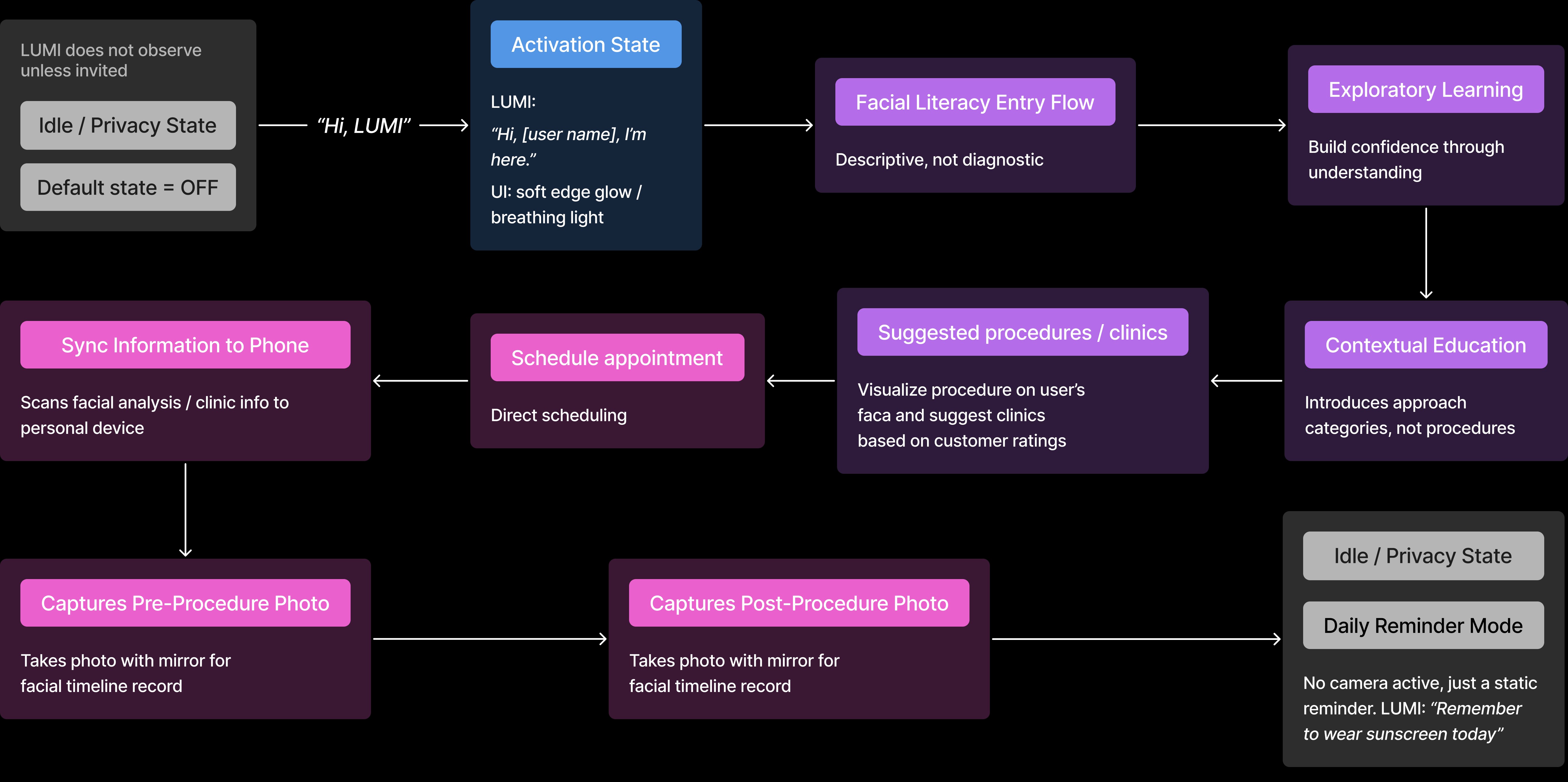
User Journey
User Journey
Design System
Design System
LUMI’s design system is built to support trust and understanding in a sensitive, private context, using soft colors, rounded forms, and gentle motion. Every element is designed to feel empathetic and educational, helping users learn without pressure or judgment in a friendly way.
LUMI’s design system is built to support trust and understanding in a sensitive, private context, using soft colors, rounded forms, and gentle motion. Every element is designed to feel empathetic and educational, helping users learn without pressure or judgment in a friendly way.

System Overview
System Overview
LUMI operates across two coordinated interfaces:
LUMI operates across two coordinated interfaces:
Bathroom Smart Mirror
Bathroom Smart Mirror
Private, reflective learning
Private, reflective learning
Mobile App
Mobile App
Follow-up, planning, and action
Follow-up, planning, and action
LUMI Interaction States
LUMI Interaction States

Default State
Default State
LUMI remains visually quiet to respect privacy and reduce cognitive load
Speaking State
Speaking State
Subtle expression and motion signal engagement and guidance
Loading State
Loading State
Gentle visual feedback reassures users that the system is working without creating urgency.
Final Outcome
Final Outcome
Flow #1
Flow #1
Medical Aesthetic Analysis
Medical Aesthetic Analysis
LUMI analyzes the user’s face in real time, revealing skin, structure, and movement through calm visual overlays. The goal is to help users understand what they’re seeing, rather than evaluate or score their appearance.
LUMI analyzes the user’s face in real time, revealing skin, structure, and movement through calm visual overlays. The goal is to help users understand what they’re seeing, rather than evaluate or score their appearance.
Flow #2
Flow #2
Introduction to Treatment
Introduction to Treatment
Based on the analysis, LUMI introduces relevant treatment categories with clear explanations of what each addresses and what it does not. Treatments are framed as contextual knowledge, not recommendations.
Based on the analysis, LUMI introduces relevant treatment categories with clear explanations of what each addresses and what it does not. Treatments are framed as contextual knowledge, not recommendations.
Flow #3
Flow #3
Medical Procedure Visualization
Medical Procedure Visualization
LUMI visualizes how medical aesthetic procedures interact with facial anatomy using subtle, educational animations. This allows users to explore mechanisms and implications without simulating outcomes or promising results.
LUMI visualizes how medical aesthetic procedures interact with facial anatomy using subtle, educational animations. This allows users to explore mechanisms and implications without simulating outcomes or promising results.
Flow #4
Flow #4
Sync to Mobile App and Book Appointment
Sync to Mobile App and Book Appointment
Insights from the mirror experience are synced to the mobile app, where users can review results, explore clinics, and book appointments. Separating action from the mirror preserves a reflective, low-pressure learning environment.
Insights from the mirror experience are synced to the mobile app, where users can review results, explore clinics, and book appointments. Separating action from the mirror preserves a reflective, low-pressure learning environment.
Takeaways
Takeaways
Designing LUMI taught me that in sensitive contexts like medical aesthetics, trust is built as much through restraint as through clarity. By focusing on helping users understand their own faces—rather than pushing recommendations—I learned how interface decisions can shape confidence, agency, and emotional safety.
Designing LUMI taught me that in sensitive contexts like medical aesthetics, trust is built as much through restraint as through clarity. By focusing on helping users understand their own faces—rather than pushing recommendations—I learned how interface decisions can shape confidence, agency, and emotional safety.